Not a gallery of finished pieces. The brief, the design gate, the three sampling rounds and the checks that decided what actually shipped — including the stage most factories leave out of the story.
14days, drawing to dispatch
3sampling rounds
4pieces in one suite
1change: centre-stone size
Case 01 · Middle East
A four-piece suite, and the one change that made it read as a set
Necklace, earrings, ring and bracelet, built around a single stone family for a retailer selling into a market where a suite is worn as one look. Fourteen days from the confirmed drawing to the box leaving the bench, across three sampling rounds.
01
The brief
A retailer sent reference images for a four-piece suite — necklace, earrings, ring and bracelet — built around one stone family. The intent was a set that photographs as a set, not four pieces that happen to match.
02
The design gate
Before CAD was released the drawing went through structural, durability and manufacturability review. Two people sign it off: the designer, and the technical engineer who has to make it.
03
Round 1
The four pieces come back as samples. This is where suites usually fail — each piece can be correct on its own and still not sit together as a family.
04
Round 2 — the one change
Centre-stone size was revised. Setting, metal weight and stone count stayed as they were; only the main stones moved up a size, so the four pieces grade against each other instead of reading as one flat wall of sparkle.
05
Round 3 — approved
The third sample became the production standard. Nobody signs a bulk run on a drawing that has not been held in the hand.
06
QC, pack, dispatch
Six checkpoints from incoming silver to the sealed carton, then photographed and released. Fourteen days from the confirmed drawing to the box leaving the bench.
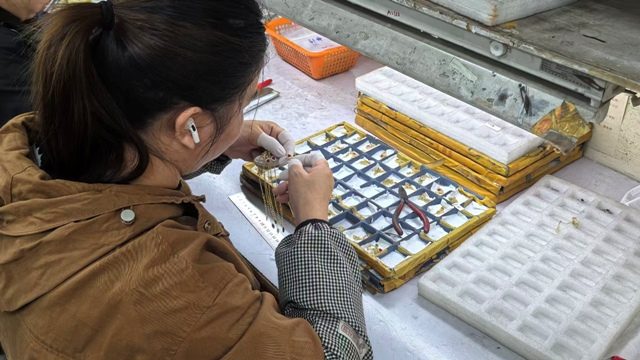
Matching the suite at the finishing table. Four pieces are four separate castings that still have to read as one family.
What the file does not show: the rounds that were rejected. A sampling round only counts when the piece is worn and photographed, not when it passes on the table.
Case 02 · Dangle earrings
The joint is the design
A dangle earring is bought for how it moves and returned for how it feels. Three decisions settle both, and none of them can be judged from a rendering.
01
The joint
A dangle is not one piece of metal. It is a chain of small articulations, and the allowance at each one decides the piece: too tight and it hangs like a pendant, too loose and it turns over, catches hair and reads cheap from the side.
02
The balance
Weight has to sit where the ear can carry it. The same drop on a thinner post becomes a two-hour earring, and the buyer finds that out on the second wear, not on the sample table.
03
The read
Layering comes from alternation — stone, metal, stone — and from how the silhouette changes as the piece moves. That is a design decision, but it is settled with engineering: which segment carries the mass, and which one is free to swing.
Checking a finished piece under the microscope before it goes to packing.
What is actually tested
Every stone nudged with tweezers — no movementClasp and post: action and alignmentDimensions by caliper, weight by scalePlated surface re-checked after platingWear-comfort pass on the finished sampleDurability pass: joint travel, hook and catch
These are the checks that can be shown on a bench. Anything a supplier tells you about comfort that was not tested on a finished piece is a claim, not a measurement.
The design gate
Before a single mould is cut
A customer's idea becomes a CAD file, and that file has to survive three reviews before anyone spends money on tooling. Two people sign each one — the designer, and the technical engineer who has to make it.
01
Structural feasibility
Wall thickness at the thinnest point, how the stone seat is cut, whether a joint has enough metal around it. A drawing that looks right and cannot carry its own stone is rejected here, not at sampling.
02
Durability
What catches on a sleeve, what fatigues at a clasp, what a plated surface has to survive. Judged against the market it is going to, because a piece sold for daily wear and a piece sold for one evening are not built to the same margin.
03
Manufacturability
Can it be cast, set, polished and plated inside tolerance, in the order the bench actually works. This is where a beautiful CAD file turns into a cost per piece.
20in-house designers
60craftsmen, 10+ years on the bench
3dedicated QC specialists
Six checkpoints, incoming silver to sealed carton
Incoming materialMould & sampleIn-process patrolFinished first checkPost-plating re-checkOutbound final
From the bench
Four clips, no voiceover
Filmed on the floor, not staged. Each one answers a question a buyer cannot settle from a product photo.
V1Wax to castingOne unbroken shot from the wax tree into the flask and out as raw castings. It is the clip that separates a factory from a trading company.
V2Stone settingTweezers, a stone tray sorted by size, and the pressure of a setting pushed home. This is the part buyers cannot verify from a photo of a finished ring.
V3InspectionCaliper, scale, loupe, and a stone nudged with tweezers to hear whether it moves. The same checks that decide a pass on the floor.
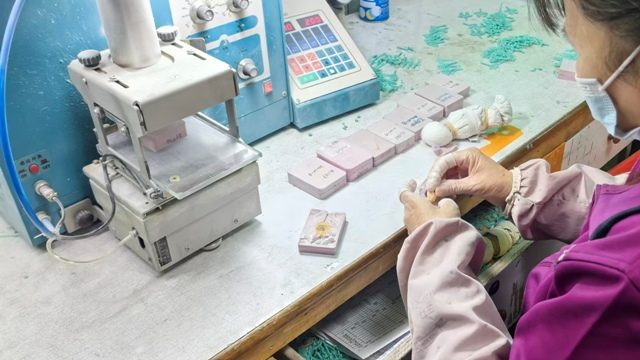
V4PackingSealed bag, desiccant, box, carton, label. The last two metres of the order, and the stage most disputes are actually about.
Next
Send the drawing. We will tell you what will break.
Structural feedback before you commit to tooling, a sampled piece before you commit to bulk, and NDA on request. Custom from 10 pieces per style — 30 where the piece is multi-stone.